
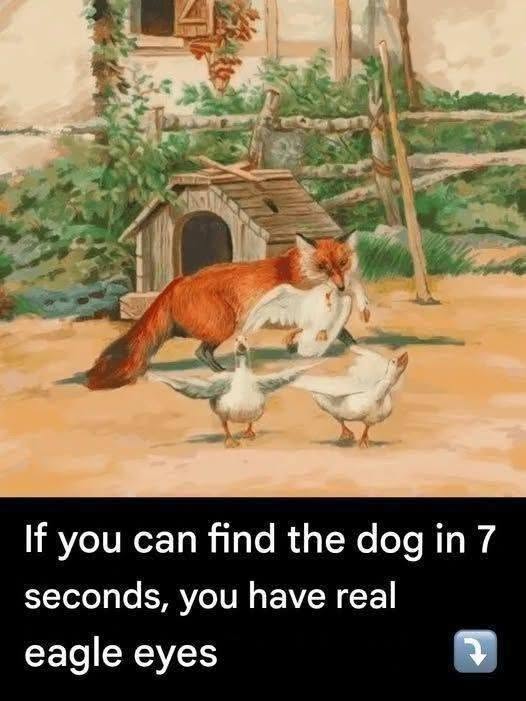
If You Can Find the Dog in 7 Seconds, You Have Real Eagle Eyes
The internet loves a good challenge.
Whether it’s optical illusions, hidden-object puzzles, brain teasers, or visual riddles, millions of people spend their free time testing their observation skills against seemingly impossible images. Some challenges ask you to spot a hidden number. Others require finding a difference between two nearly identical pictures.
But every now and then, a puzzle appears that leaves even the sharpest observers scratching their heads.
One of the latest visual challenges taking social media by storm comes with a simple claim:
“If you can find the hidden dog in 7 seconds, you have real eagle eyes.”
Sounds easy enough, right?
After all, dogs aren’t exactly tiny creatures. Most people assume they’ll locate the animal almost immediately.
Then they look at the image.
And suddenly those seven seconds feel a lot shorter.
The challenge has become popular because it perfectly demonstrates how our brains process visual information—and how easily our eyes can be tricked by patterns, colors, and distractions.
Before we reveal why these puzzles are so difficult, let’s explore what makes hidden-object challenges so fascinating and why millions of people can’t resist trying them.
The Hidden Dog Challenge
Imagine looking at a busy scene.
Perhaps it’s a forest.
A garden.
A rocky landscape.
Or maybe a crowded park.
At first glance, everything appears completely ordinary.
Trees blend into bushes.
Shadows merge with rocks.
Leaves create endless patterns.
Then comes the challenge:
Find the dog in just seven seconds.
Many people confidently start searching.
One second passes.
Then two.
Then five.
Before they know it, seven seconds are gone and they still haven’t found the animal.
Sound familiar?
You’re not alone.
Studies on visual perception suggest that the human brain often focuses on expected patterns while filtering out information it considers unimportant.
Ironically, that filtering process can make hidden objects harder to detect.
Why Hidden Objects Are So Difficult to Spot
Many people assume seeing is a simple process.
Open your eyes.
Look around.
Observe what’s there.
In reality, vision is much more complicated.
Your brain constantly receives enormous amounts of visual information.
To avoid becoming overwhelmed, it selectively prioritizes certain details while ignoring others.
This process helps you function efficiently in daily life.
However, it also creates opportunities for visual illusions and hidden-object puzzles.
When a dog’s fur matches surrounding colors or textures, your brain may mistakenly categorize it as part of the background.
As a result, the dog remains invisible even when you’re looking directly at it.
What Does “Eagle Eyes” Really Mean?
The phrase “eagle eyes” has become synonymous with exceptional vision and observation skills.
Eagles are famous for their remarkable eyesight.
Compared to humans, they can detect prey from impressive distances while soaring high above the ground.
Although no hidden-object puzzle can determine whether someone literally possesses eagle-like vision, these challenges do test several important visual abilities:
- Pattern recognition
- Attention to detail
- Focus
- Spatial awareness
- Visual scanning speed
People who quickly solve visual puzzles often excel at identifying small inconsistencies in complex environments.
The Psychology Behind Visual Challenges
Part of the appeal of these puzzles comes from curiosity.
The moment someone says, “Most people can’t find it,” the brain becomes motivated to prove otherwise.
This phenomenon is related to what psychologists call the challenge effect.
Humans naturally enjoy testing their abilities.
We want to know:
- Can I solve it?
- Am I faster than others?
- Did I notice something everyone else missed?
These questions transform a simple image into an engaging mental game.
That’s why optical illusion posts frequently receive thousands—or even millions—of shares online.
Why Some People Find the Dog Faster
Have you ever noticed that some people locate hidden objects almost instantly while others struggle?
Several factors can influence performance.
Experience
People who regularly solve puzzles often develop efficient scanning techniques.
Instead of looking randomly, they systematically examine sections of an image.
Attention to Detail
Certain individuals naturally notice subtle visual differences more quickly.
This skill can be beneficial in many professions, including:
- Design
- Quality control
- Investigation
- Medical imaging
- Engineering
Patience
Interestingly, rushing often makes hidden-object puzzles more difficult.
People who remain calm tend to observe details more effectively.
Visual Search Strategies
Experts recommend dividing an image into sections rather than scanning the entire picture at once.
This method reduces visual overload and increases the likelihood of finding hidden objects.
la suite dans la page suivante
