
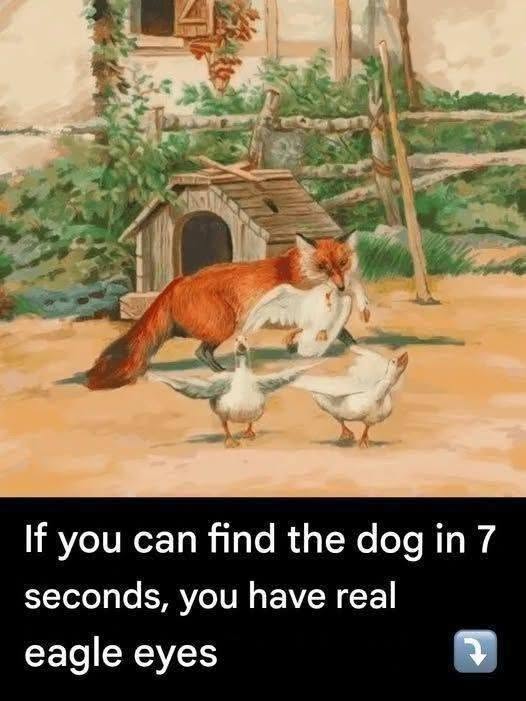
Common Tricks Used in Hidden-Dog Puzzles
Puzzle creators rely on several clever techniques to hide animals effectively.
Color Camouflage
The dog’s fur closely matches surrounding objects.
Brown fur blends into tree bark.
White fur disappears in snowy landscapes.
Gray fur merges with rocks and shadows.
Partial Visibility
Sometimes only part of the dog is visible.
Perhaps an ear.
A tail.
Or a small section of its face.
Because viewers expect to see the entire animal, they overlook these clues.
Distracting Elements
Busy backgrounds make visual searching much harder.
The more details an image contains, the easier it becomes for the hidden object to disappear.
Pattern Confusion
Natural environments often contain repeating shapes and textures.
These patterns trick the brain into overlooking important visual information.
What Happens in Your Brain During the Search?
When you begin looking for the hidden dog, several brain regions become active.
Your visual cortex processes shapes, colors, and movement.
Your attention networks help direct focus toward relevant areas.
Your memory system recalls what dogs typically look like.
Together, these systems attempt to identify a match.
However, if the dog blends perfectly into the environment, the brain may repeatedly misclassify it as background scenery.
This explains why some people suddenly spot the dog after staring at the image for several minutes.
The information was always visible.
The brain simply needed time to interpret it correctly.
The Growing Popularity of Visual Brain Teasers
In recent years, visual puzzles have exploded in popularity.
Social media platforms are filled with posts challenging users to:
- Find hidden animals
- Spot differences
- Identify odd objects
- Solve optical illusions
- Discover concealed faces
Why are they so popular?
Because they offer instant engagement.
Unlike lengthy games or complex puzzles, visual challenges can be attempted in seconds.
People enjoy sharing results with friends and comparing performance.
The competitive element makes these challenges even more entertaining.
Can These Puzzles Improve Your Brain?
Many enthusiasts believe hidden-object puzzles help sharpen mental skills.
While they won’t magically increase intelligence, visual challenges may support certain cognitive abilities.
Potential benefits include:
Improved Concentration
Searching for hidden details requires sustained focus.
Enhanced Observation Skills
Frequent puzzle-solving encourages greater attention to visual information.
Mental Stimulation
The brain enjoys solving problems and identifying patterns.
Stress Relief
For many people, puzzles provide a relaxing break from daily responsibilities.
The satisfaction of finding the hidden object can also trigger positive feelings and a sense of accomplishment.
Tips for Finding Hidden Objects Faster
Want to improve your chances of spotting the dog within seven seconds?
Try these strategies:
Scan Methodically
Divide the image into smaller sections.
Search one area at a time.
Look for Unusual Shapes
Instead of searching specifically for a dog, look for shapes that seem out of place.
Focus on Edges
Hidden objects often become visible where their outlines contrast slightly with the background.
Change Perspective
Sometimes moving farther from the screen helps reveal hidden patterns.
Other times zooming in makes details easier to detect.
Stay Relaxed
Frustration can narrow attention and make searching more difficult.
A calm approach often produces better results.
Why We Love Being Challenged
There’s a reason visual puzzles continue to captivate people of all ages.
They tap into fundamental aspects of human nature.
We enjoy discovery.
We enjoy competition.
We enjoy proving our abilities.
Most importantly, we enjoy the moment when confusion suddenly transforms into clarity.
That instant when the hidden dog finally appears can feel surprisingly rewarding.
What was invisible a moment ago becomes impossible to miss.
It’s a reminder that perception is not always as straightforward as it seems.
Did You Find the Dog?
If you spotted the hidden dog within seven seconds, congratulations.
You likely possess excellent observation skills and strong visual attention.
If it took longer, don’t worry.
Many of these puzzles are intentionally designed to be difficult.
The goal isn’t necessarily to find the answer immediately.
The fun comes from the challenge itself.
In fact, some people spend several minutes studying an image before finally discovering the hidden animal.
And once they see it, they often wonder how they missed it in the first place.
That’s the magic of visual puzzles.
They reveal just how fascinating—and sometimes misleading—human perception can be.
Final Thoughts
The “Find the Dog in 7 Seconds” challenge may seem like a simple internet game, but it highlights something remarkable about the human brain. Our eyes constantly gather information, yet our minds decide what receives attention and what fades into the background.
Whether you located the hidden dog instantly or needed extra time, the challenge serves as a fun reminder that observation is a skill worth developing.
The next time you encounter a hidden-object puzzle online, give it a try. You might discover that your eyes are sharper than you think—or that your brain still has a few surprises left to reveal.
And who knows?
Maybe you really do have eagle eyes after all.
la suite dans la page suivante
