TRUMP CLAIMS SECRET GOVERNMENT DRUG CAN RESURRECT THE DEAD AND THE WORLD IS IN TOTAL SHOCK… See more

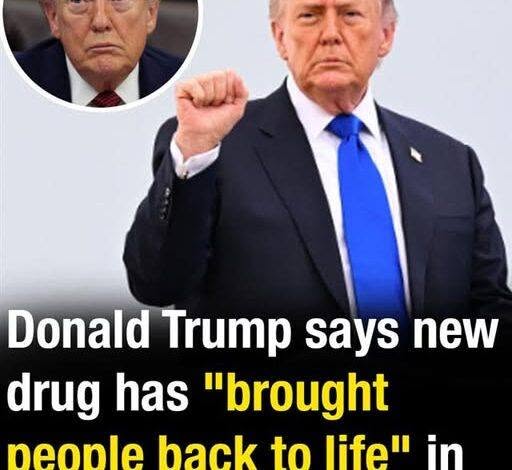
However, there is a yawning chasm between the legal framework of the Right to Try Act and the claim that a drug can “revive” someone who has crossed the threshold of death. Medical science has very clear, rigid definitions for biological death, and there is absolutely zero evidence—scientific or otherwise—that any experimental medication currently in existence has the power to reverse the cessation of brain activity or cardiovascular function once death has been confirmed. By blurring the lines between experimental therapy for the terminally ill and the supernatural promise of resurrection, Trump has invited a level of scrutiny that far exceeds the normal limits of political hyperbole.
This incident is not an isolated event but rather the latest chapter in a long-standing pattern where the former president’s rhetoric has collided violently with established facts. Throughout his political career, his tendency to inflate his accomplishments and describe complex issues in dramatic, often impossible terms has been a signature of his communication strategy. Supporters often argue that his statements should be viewed as illustrative metaphors rather than literal claims, but this particular instance has proven difficult to spin. The subject matter—life and death—is too fundamental, and the claim is too specific, for it to be easily dismissed as mere political showmanship.
The broader implications of this narrative are deeply concerning to the scientific community, which is already fighting an uphill battle against the spread of medical misinformation. When influential voices suggest that the government possesses “secret” or “ultimate” solutions that defy standard scientific protocols, it sows distrust in the institutions—like the FDA and clinical research centers—that are designed to keep the public safe. The medical establishment works on a framework of peer-reviewed data, double-blind trials, and rigorous safety standards precisely to prevent the exact kind of unchecked experimentation that Trump described.
As the backlash continues to gain momentum, the question remains whether the campaign will offer a formal clarification or simply move on to the next headline. For his critics, this is further proof that the former president lives in a reality of his own making, untethered from the constraints of logic or empirical data. For his base, it may simply be another instance of a leader who thinks in bold, aspirational terms, even when those terms enter the realm of the impossible. Regardless of the intent behind the words, the result is a bewildered public left to wonder how a man seeking to lead the most powerful nation on earth can speak so confidently about miracles that contradict every known principle of biology.In a political climate where the stakes are perpetually high and the polarization is absolute, this incident serves as a stark reminder of the power of words. Whether it is a result of a genuine misunderstanding, a deliberate attempt to shock, or a sign of deeper confusion, the claim has succeeded in capturing the national attention. It forces us to ask what we expect from our leaders: do we want comfort, hyperbole, or a strict, perhaps boring, adherence to the truth? As the debate rages on, the only thing that remains perfectly clear is that no drug currently exists that can bring the dead back to life, and no amount of political spin can change that fundamental, irreversible fact of human existence.
la suite dans la page suivante
